


The treadmill used to offer a tidy account of a workout. It told you how far you had gone, how long it had taken and how many calories you had supposedly burned. The scale at home supplied another number. For much of the fitness culture marketed to women, these figures formed a familiar record of progress. The training log beside a set of dumbbells tells a different story.
There, the details are about what happened during the movement. An exercise that once felt awkward is becoming familiar. The same weight can be lowered more steadily. The last repetition looks much like the first. Strength training for women makes these changes worth noticing, whether the aim is to take up a new sport, return to exercise after a long break or move more comfortably through an ordinary week.
Some of the clearest examples happen away from the gym. Carrying a bag upstairs leaves one hand free for the banister. A suitcase can be lifted into a luggage rack without a second attempt. A low seat feels easier to get out of. These are modest changes, but they have a bearing on how freely we move through the places we live and travel.
What Strength Training for Women Can Change
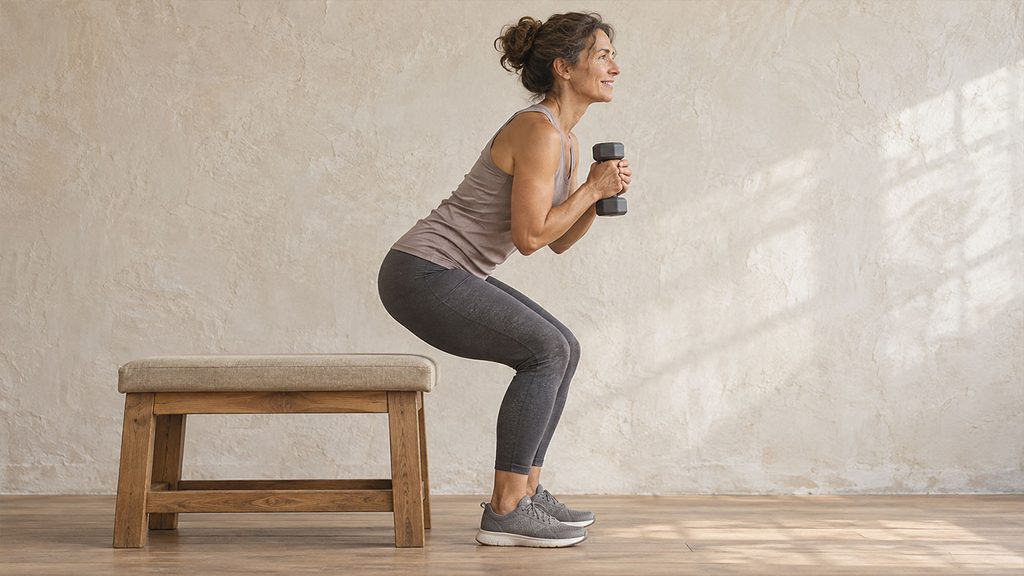
Strength training asks muscles to work against resistance. That resistance can come from a dumbbell, a machine, an elastic band or your own body weight. Rising from a chair and standing up from a weighted squat share a basic movement. The chair gives you a consistent height to work from. A dumbbell adds a load you can adjust as the exercise becomes more familiar.
Muscle strength and muscle size describe different aspects of adaptation. When you first learn an exercise, some of the work is simply finding a position and rhythm you can repeat. You may become steadier on the way down or find it easier to stand up with the same weight. A change in how your clothes fit may be weeks away, while the difference in how you perform the exercise is already apparent.
In its 2026 review of resistance training in healthy adults, the American College of Sports Medicine found benefits for muscle strength and physical performance. The details of a programme depend on what you want to improve. Heavier loads can be useful when building maximal strength is the priority. Bodyweight exercises and resistance bands also offer ways to work against resistance, including at home. ACSM review of resistance training
How Strength Carries Over into Everyday Life
In a training room, the weights have handles and the floor is level. Everyday loads are less accommodating. A full pot has to come off the hob and travel safely to the counter. A shopping bag hangs on one side while the other hand searches for keys. Strength is one part of what makes these movements manageable, alongside balance, coordination and the ability to adjust to the space around you.
Training gives you a chance to practise parts of those movements under repeatable conditions. Standing up from a bench works the legs and hips. Pulling a resistance band towards the body gives you a controlled way to practise a pulling movement. Walking a short distance with a weight in one hand combines grip with the work of staying steady as you take each step. VOGGIA’s guide to calisthenics explores how bodyweight movements can be adapted as skill and strength develop.
A training log is most informative when it records the conditions as well as the numbers. Standing up from a lower bench changes the distance you move. Completing another repetition at the same height changes how much work you do. Writing down which of those things improved tells you more about the session than recording the weight alone.
Muscle Strength and Bone Health After Menopause
Muscle strength can decline with age. Its effects may be felt in decisions so small they scarcely register at first. You divide the groceries into lighter bags. You choose the chair with arms because it is easier to stand up from. You pause before stepping down from a high kerb. Strength is one factor in those decisions, alongside mobility, balance and individual health.
After menopause, bone health adds another dimension to the discussion. A systematic review of controlled trials in postmenopausal women found that resistance training could benefit bone mineral density at several sites, including the lumbar spine and hip. The findings varied by site and by programme. An exercise routine described in one study may differ considerably from another in the loads used, the length of the programme and the people taking part. Systematic review of resistance training and bone mineral density after menopause
You may notice an improvement in strength as you move. Bone mineral density is measured clinically, and changes in it are a separate outcome. For someone with osteoporosis or a previous fracture, the choice of exercise and load depends on an individual assessment. That distinction matters when turning research on a group of participants into decisions about a particular person’s training.
How to Start a Strength Training Routine
A weekly routine can make room for both aerobic activity and strength work. The World Health Organization recommends that adults work the major muscle groups on at least two days a week, alongside aerobic activity. If you already walk, swim or cycle regularly, strength work can occupy its own place in the week. How you begin depends on which movements feel accessible and where you are most likely to practise them regularly. WHO physical activity guidance
A Few Movements to Learn First
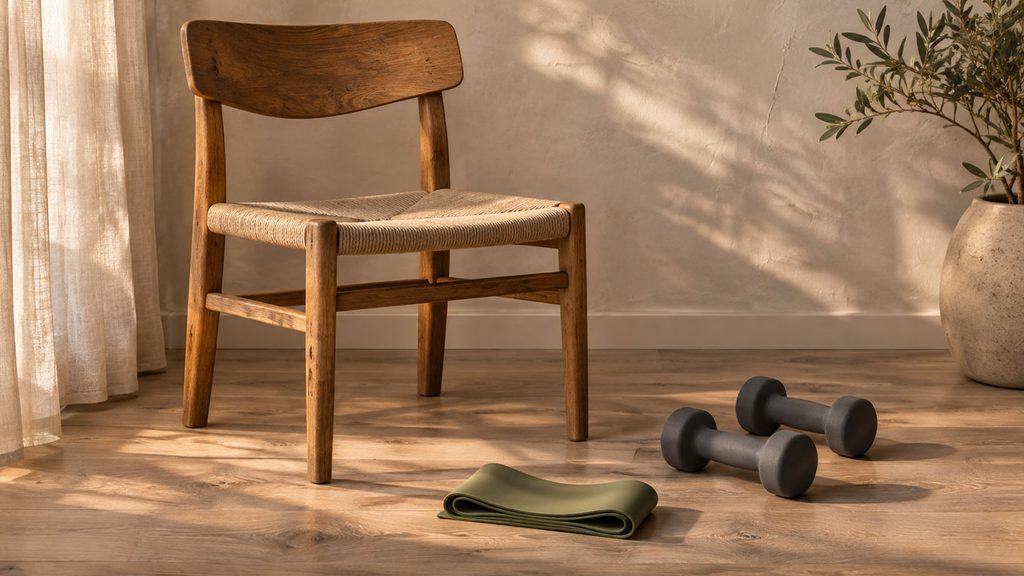
At home, a sturdy chair, a clear wall and a resistance band make several movements possible. A chair rise works the legs. A wall push-up introduces a pushing movement. A band row gives you a way to practise pulling. At a gym, machines and dumbbells can make the load easier to adjust in small increments. The setting matters partly for practical reasons. A gym on the way home may fit easily into the week, while clearing a corner of the living room may make more sense on days when time is tight.
When to Make an Exercise More Challenging
Repeating a few movements under similar conditions helps you judge when they are becoming easier. Once a chair rise feels steady, you might add a repetition or introduce a small weight. Changing one element at a time makes the next session easier to interpret. You can see how you responded to the extra work without having to account for a different exercise, a lower seat and a heavier load all at once.
VOGGIA’s piece on the place of difficult workouts in a training practice looks at the relationship between effort and discipline. For someone just starting out, a productive level of effort leaves room to learn the movement and repeat it on another day. The ACSM review found no consistent advantage for the average healthy adult in taking every set to the point where another repetition is impossible. ACSM review of resistance training
Where Creatine Fits
Creatine can support performance during short, intense efforts repeated with brief periods of recovery. In a strength session, this might mean a series of demanding sets with rest between them. According to the US National Institutes of Health’s Office of Dietary Supplements, creatine monohydrate is the most widely studied supplemental form. When weighing a claim about a particular product, the form used in the research is worth checking. NIH guidance on exercise and performance supplements
Creatine can also increase body weight through water retention, another reason a single reading on the scale tells only part of the story. Supplementation is optional. If you are new to strength training, the first few weeks offer plenty to observe in the exercises themselves, from how reliably you can repeat a movement to how the same load feels at the end of a session. NIH consumer guide to performance supplements
The VOGGIA Perspective
Wellness is easy to photograph when it has a setting. A studio with good morning light, a neatly arranged rack of weights, a chair pulled into an empty corner of a room. Those details can make exercise inviting. What happens after months of returning to the same place is harder to capture in a single frame.
Perhaps you used to look for the arm of a chair before standing up. One evening, halfway through a conversation, you get up to fetch something and realise you never reached for it. There would be little to see in a photograph of that moment. You would know exactly what had changed.


